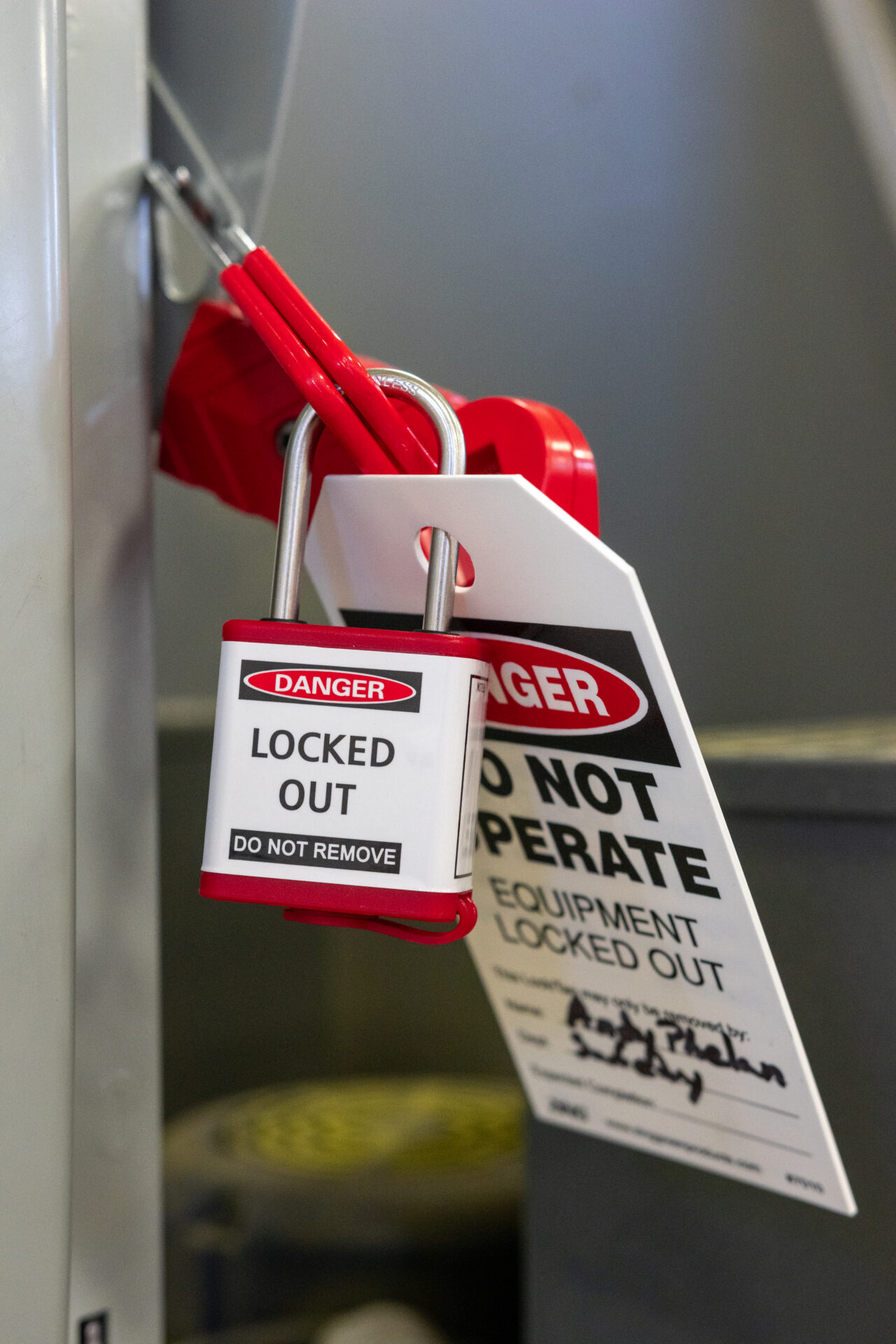


Contractors and host employers must coordinate their energy-control procedures before servicing begins. Learn how to manage contractor LOTO safely and comply with OSHA requirements.
Industrial facilities frequently hire outside contractors to install machinery, repair production equipment, perform electrical work, complete shutdown maintenance, or service specialized systems. When this work exposes employees to hazardous energy, both the contractor and the facility have important obligations.
Contractor lockout tagout responsibilities should be established before outside personnel begin servicing equipment. The host employer cannot simply turn the project over to a contractor and assume the contractor will manage every energy-control issue independently.
Likewise, the contractor cannot arrive at an unfamiliar facility and begin applying locks without understanding the facility’s equipment, energy sources, operating conditions, and established procedures.
OSHA requires the on-site employer and outside employer to inform each other of their respective lockout or tagout procedures. The on-site employer must also ensure that its employees understand and comply with the restrictions and prohibitions of the outside employer’s energy-control program.
Effective contractor lockout tagout responsibilities depend on communication, coordination, employee accountability, and a clear assignment of control.
When Does OSHA’s LOTO Standard Apply to Contractors?
OSHA’s Control of Hazardous Energy standard generally applies when employees perform servicing or maintenance and could be injured by unexpected energization, startup, or the release of stored energy.
Covered contractor work may include:
- Installing industrial machinery
- Repairing production equipment
- Replacing motors, pumps, belts, or drives
- Servicing hydraulic or pneumatic systems
- Performing electrical maintenance
- Entering robotic cells
- Clearing serious equipment jams
- Modifying conveyors
- Repairing boilers or process systems
- Completing shutdown or turnaround work
- Testing and positioning equipment during repairs
- Cleaning machinery where hazardous-energy exposure exists
Outside servicing personnel performing covered work must comply with the applicable requirements of 29 CFR 1910.147.
Contractor lockout tagout responsibilities should therefore be addressed during project planning—not after tools and personnel have already arrived.
What Must the Host Employer and Contractor Exchange?
Before servicing begins, the host employer and contractor must inform each other of their respective energy-control procedures.
This exchange should be specific enough for both employers to understand how hazardous energy will be controlled during the project.
Important information may include:
- The host facility’s general LOTO policy
- The contractor’s energy-control program
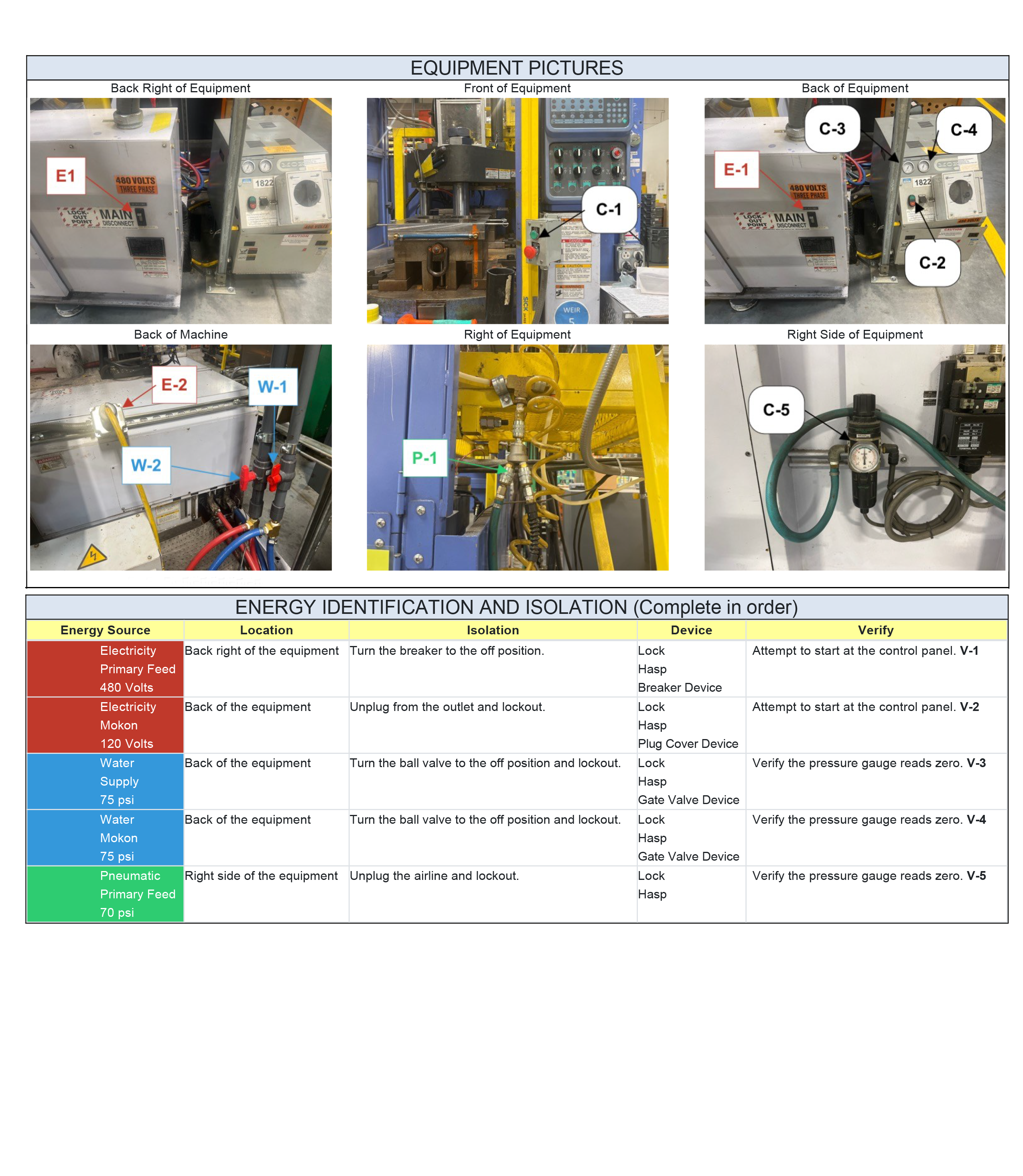
- Machine-specific isolation procedures
- Identified hazardous-energy sources
- Locations of disconnects, valves, and isolation points
- Stored-energy hazards
- Group-lockout methods
- Personal lock requirements
- Lock and tag identification systems
- Shift-change procedures
- Testing and positioning procedures
- Absent-employee lock-removal rules
- Emergency response procedures
- Equipment restart authorization
- Required training and qualifications
A brief statement that both organizations “follow OSHA” is not enough. Contractor lockout tagout responsibilities should identify the procedures employees will actually follow at the equipment.
The host employer should also disclose hazards that may not be obvious to an outside worker, such as remote energy sources, interconnected machinery, automatic restart functions, backup power, gravity hazards, accumulators, or process pressure.
Host-Employer Responsibilities
The host employer generally has the most detailed knowledge of the facility and its equipment. It should provide contractors with accurate, site-specific information before work begins.
Host-employer responsibilities commonly include:
- Identifying covered equipment
- Providing applicable machine-specific procedures
- Explaining facility LOTO rules
- Identifying known hazardous-energy sources
- Coordinating production shutdowns
- Informing affected employees
- Controlling access to the work area
- Explaining emergency procedures
- Identifying facility contacts
- Coordinating multiple contractors
- Confirming that contractor methods do not conflict with facility operations
- Preventing employees from violating the contractor’s restrictions
OSHA specifically requires the on-site employer to ensure its employees understand and comply with the restrictions and prohibitions associated with the outside employer’s energy-control procedures.
For example, facility employees should understand that they may not operate a disconnect, remove a contractor’s device, attempt to start the machine, bypass a barricade, or interfere with the contractor’s lockout.
Documenting contractor lockout tagout responsibilities helps the host employer communicate these restrictions consistently.
Contractor-Employer Responsibilities
The contractor remains responsible for protecting its own employees and ensuring they follow an effective energy-control program.
Contractor-employer responsibilities commonly include:
- Providing trained authorized employees
- Following OSHA’s hazardous-energy-control requirements
- Explaining the contractor’s procedure to the host employer
- Reviewing site-specific hazards
- Inspecting the equipment before work begins
- Applying appropriate locks and tags
- Verifying energy isolation
- Controlling stored energy
- Maintaining employee accountability
- Coordinating group lockout
- Managing shift changes
- Following the facility’s access and communication rules
- Reporting previously unidentified hazards
- Removing contractor devices properly
- Confirming work completion before equipment release
The contractor should not assume that the host employer’s shutdown of a machine automatically protects contractor personnel.
Contractor employees must understand the type and magnitude of the energy involved and the methods required to isolate and control it. Contractor lockout tagout responsibilities remain applicable even when the facility assists with shutdown or operates certain disconnects.
Who Controls the Lockout?
One of the most important planning decisions is determining who controls the overall lockout.
Possible arrangements include:
- The host employer controls the lockout
- The contractor controls the lockout
- The host isolates the equipment and contractors apply personal locks
- A designated authorized employee coordinates a group lockout
- Multiple contractors participate through a controlled lockbox system
The selected method should be documented before servicing begins.
The procedure should identify:
- Who shuts down the equipment
- Who operates each energy-isolating device
- Who verifies isolation
- Who controls the keys
- Where personal locks are applied
- Who maintains the employee roster
- Who authorizes testing
- Who approves temporary reenergization
- Who authorizes final release
- Who notifies affected employees
Clear contractor lockout tagout responsibilities prevent employees from assuming that another company completed a critical step.
Verifying Energy Isolation
Contractor employees should not rely solely on a verbal statement that the equipment has been locked out.
Before servicing begins, authorized employees should verify that the isolation is effective. Verification may include:
- Attempting to operate normal controls
- Testing electrical circuits
- Checking pressure gauges
- Confirming valves are closed
- Verifying stored pressure has been released
- Inspecting blocking devices
- Confirming capacitors have discharged
- Checking for gravity hazards
- Verifying connected equipment cannot introduce energy
The host employer should explain any unusual or machine-specific verification methods.
OSHA has stated that the contractor employer is not necessarily required to independently audit the host employer’s entire energy-control program. However, both employers must exchange information about their procedures, and each employer remains responsible for protecting its employees.
A practical contractor lockout tagout responsibilities checklist should require verification at the equipment before work starts.
Group Lockout With Contractors
Large projects often involve facility maintenance workers, electricians, millwrights, equipment vendors, and multiple outside contractors.
When more than one crew, craft, department, or employer is involved, the group-lockout procedure should assign overall responsibility to a designated authorized employee who coordinates the affected workforces and ensures continuity of protection.
Large projects often involve facility maintenance workers, electricians, millwrights, equipment vendors, and multiple outside contractors.
When more than one crew, craft, department, or employer is involved, the group-lockout procedure should assign overall responsibility to a designated authorized employee who coordinates the affected workforces and ensures continuity of protection.
Each authorized employee must apply a personal lockout or tagout device when work begins and remove it when work stops.
A contractor group-lockout procedure should address:
- The primary authorized employee
- Participating employers
- Employee sign-in and sign-out
- Personal lock placement
- Group lockbox control
- Isolation-point verification
- Changes in project scope
- Employees joining or leaving
- Shift and personnel changes
- Testing and positioning
- Final equipment release
Contractor lockout tagout responsibilities should never be reduced to a supervisor applying one lock for an entire contractor crew unless the overall system still provides each exposed employee with protection equivalent to a personal device.
Contractor Shift Changes
Contractor projects may continue through multiple shifts or several days. The procedure must maintain continuous protection while personnel change.
OSHA requires specific procedures for shift or personnel changes, including an orderly transfer between outgoing and incoming employees. Group-lockout operations that extend into another shift must also follow these personnel-change requirements.
The transfer should include:
- Reviewing work completed and remaining
- Identifying active energy controls
- Inspecting the equipment
- Verifying isolation
- Updating the employee roster
- Applying incoming personal locks
- Removing outgoing personal locks
- Transferring group leadership
- Documenting unusual conditions
Contractor lockout tagout responsibilities should identify who remains accountable when a contractor supervisor or primary authorized employee leaves the site.
Temporary Reenergization for Testing
Contractors may need to temporarily energize equipment to test a repair, check motor rotation, position a component, or verify operation.
The host employer and contractor should agree in advance on:
- When temporary energization is permitted
- Who may authorize the test
- The required OSHA sequence
- Employee-clearance procedures
- Group-lockout coordination
- Stored-energy reassessment
- Communication methods
- Safe observation positions
- Reapplication of energy controls
- Verification before servicing resumes
No employee should resume servicing until the equipment has been deenergized, locked out again, and verified.
Including testing requirements in contractor lockout tagout responsibilities prevents informal or unauthorized startups during maintenance.
What If Contractor Procedures Differ?
A contractor’s LOTO procedure may differ from the host employer’s process.
Examples include different:
- Lock colors
- Tag formats
- Group lockboxes
- Sign-in methods
- Verification steps
- Shift-transfer systems
- Lock-removal authorization procedures
- Documentation requirements
Differences do not automatically make either program unacceptable. However, the employers must identify and resolve conflicts before work begins.
The project plan should clarify which procedure governs each activity and how the systems will interact. Employees should not be expected to interpret conflicting rules in the field.
The project plan should clarify which procedure governs each activity and how the systems will interact. Employees should not be expected to interpret conflicting rules in the field.
A pre-job meeting is one of the best ways to clarify contractor lockout tagout responsibilities.
Removing a Contractor’s Lock
A contractor employee should normally remove the personal lock they applied.
When the employee is unavailable, a device may be removed only under a documented employer procedure with specific safeguards. OSHA requires verification that the employee is not at the facility, reasonable efforts to contact the employee, and assurance that the employee knows the device was removed before returning to work.
The host employer should not cut off a contractor’s lock simply because:
- The contractor left for the day
- Production needs to restart
- The lock appears to have been forgotten
- The project supervisor cannot immediately identify the owner
- Another contractor needs access
Contractor lockout tagout responsibilities should state which employer directs an absent contractor lock removal and what documentation is required.
A Pre-Job Contractor LOTO Meeting
Before work begins, the host employer and contractor should conduct a documented coordination meeting.
The meeting should cover:
- Scope of the work
- Equipment involved
- Machine-specific procedures
- Hazardous-energy sources
- Isolation points
- Employee roles
- Lockout leadership
- Group-lockout methods
- Contractor identification
- Communication procedures
- Shift changes
- Testing and positioning
- Emergency response
- Equipment release
- Required documentation
Participants should have an opportunity to inspect the equipment and ask questions.
The meeting record can demonstrate that contractor lockout tagout responsibilities were discussed before employees were exposed.
Common Contractor LOTO Mistakes
Training and Oversight
Contractor employees performing covered servicing must be properly trained as authorized employees. The host employer should also prepare its affected employees to comply with the restrictions created by the contractor’s lockout.
Training and orientation should address:
- Facility-specific hazards
- Machine-specific procedures
- Authorized and affected employee roles
- Personal-lock requirements
- Group-lockout procedures
- Verification methods
- Communication expectations
- Emergency contacts
- Shift-transfer procedures
- Prohibited actions
The host employer may also observe work, review records, and intervene when it identifies an unsafe condition. Contract language does not eliminate either employer’s independent obligation to protect its employees.
OSHA’s multi-employer citation policy recognizes that, depending on the facts, more than one employer may be citable for a hazardous condition at a multi-employer worksite.
Written contractor lockout tagout responsibilities provide an objective basis for monitoring the work.
Managing Contractor LOTO Digitally
Paper forms, contractor binders, and disconnected spreadsheets can make it difficult to coordinate multiple employers.
A digital LOTO-management system can help facilities:
- Maintain machine-specific procedures
- Display energy-source photographs
- Identify isolation points
- Record participating employers
- Assign the primary authorized employee
- Track personal-lock participation
- Maintain contractor rosters
- Document verification
- Record shift transfers
- Capture testing activities
- Attach notes and photographs
- Maintain procedure revisions
- Produce centralized compliance records
Smart Safety Pro helps industrial facilities and safety consultants create, manage, validate, and inspect machine-specific lockout/tagout procedures.
Mobile access allows host-employer and contractor personnel to review energy sources, isolation steps, photographs, and validation requirements directly at the equipment.
Final Takeaway
Contractor lockout tagout responsibilities are shared through coordination, but each employer retains responsibility for protecting its own employees.
The host employer and contractor must exchange information about their energy-control procedures. The host employer must ensure its employees understand and comply with the outside employer’s restrictions. The contractor must provide trained personnel and follow an effective procedure throughout the work.
Before servicing begins, the employers should determine who controls the lockout, how isolation will be verified, how personal devices will be managed, how multiple crews will be coordinated, and who may authorize equipment release.
Smart Safety Pro provides mobile tools for documenting hazardous-energy sources, displaying machine-specific isolation steps, capturing equipment photographs, performing periodic inspections, and maintaining centralized LOTO records.
Frequently Asked Questions
This article provides general information about OSHA lockout/tagout requirements and is not legal advice. Employers should evaluate each machine, task, energy source, and workplace condition individually and consult qualified safety or legal professionals when necessary.