
In this article, we’ll learn how often a LOTO procedure review should be performed, what OSHA requires for annual periodic inspections, who can perform them, and when procedures should be updated.
Lockout/tagout procedures are designed to protect employees from the unexpected startup of machinery or the release of hazardous energy during servicing and maintenance. But creating a lockout/tagout procedure is only the beginning. Employers must also make sure procedures remain accurate, employees understand their responsibilities, and the procedures are actually being followed in the workplace.
Regular LOTO procedure review is an essential part of an effective hazardous energy control program.
Under OSHA’s Control of Hazardous Energy standard, employers must conduct a periodic inspection of each applicable energy control procedure at least annually. However, an annual inspection should not be viewed as the only time a lockout/tagout procedure should be evaluated. Equipment modifications, process changes, employee observations, incidents, and other circumstances may require a procedure to be reviewed sooner.
Understanding when and how to perform a LOTO procedure review can help employers keep procedures accurate while reducing the risk of employees relying on outdated energy-control instructions.
What Does OSHA Require for a LOTO Procedure Review?
OSHA’s lockout/tagout requirements are found in 29 CFR 1910.147, commonly known as the Control of Hazardous Energy standard.
According to OSHA, employers must conduct a periodic inspection of an energy control procedure at least annually to verify that the procedure and the requirements of the standard are being followed.
OSHA has further clarified that each energy control procedure subject to the standard must be separately inspected at least annually.
For most facilities, this means establishing a systematic LOTO procedure review program instead of waiting until the end of the year and attempting to audit every procedure at once.
For example, a manufacturing facility with 300 machine-specific procedures could schedule approximately 25 inspections per month throughout the year. Spreading inspections across the calendar can make the program easier to manage while still maintaining the required inspection cycle.
Is a LOTO Procedure Review the Same as an Annual Inspection?
The terms are frequently used interchangeably, but it is helpful to distinguish between reviewing the written procedure and performing OSHA’s required periodic inspection.
An OSHA periodic inspection involves more than reading the document.
OSHA guidance states that periodic inspections must include both an inspection of the energy control procedure and a review of employee responsibilities under the procedure. The inspection must be performed by an authorized employee other than the employee or employees using the procedure being inspected.
OSHA has also explained that the periodic inspection must, at minimum, include a demonstration of the procedure while authorized employees are performing servicing or maintenance activities.
A proper LOTO procedure review should therefore verify not only what the document says but also whether the instructions accurately represent what happens at the machine..
What Should Be Checked During a LOTO Procedure Review?
An effective inspection should confirm that the procedure accurately identifies the hazardous energy associated with the equipment and provides employees with the information necessary to control it safely.
The reviewer should examine items such as:
- Energy sources associated with the equipment
- Energy-isolation devices
- Disconnect locations
- Electrical, hydraulic, pneumatic, mechanical, thermal, gravitational, or other stored energy
- Steps required to shut down equipment
- Methods for dissipating or restraining stored energy
- Lockout or tagout device application
- Verification of a zero-energy state
- Steps required for safely returning equipment to service
- Employee responsibilities under the procedure
The inspector should also observe employees performing the procedure and identify deviations between the written instructions and actual field conditions.
A LOTO procedure review is particularly valuable for discovering small changes that might otherwise go unnoticed. A disconnect may have been replaced, a valve may have been relocated, labeling may have changed, or new equipment may have been connected to an existing system.
Even a seemingly minor modification can affect the accuracy of an energy control procedure.
When Should LOTO Procedures Be Reviewed Before the Annual Inspection?
Annual inspection is the minimum periodic requirement, but employers should not wait for the scheduled anniversary when circumstances indicate that a procedure may no longer be accurate.
A LOTO procedure review should be considered whenever there is a meaningful change involving the equipment, energy sources, procedures, or employees’ ability to properly apply the procedure.
Common triggers include:
Who Should Conduct the Annual LOTO Inspection?
OSHA requires the periodic inspection to be conducted by an authorized employee other than the employee or employees using the energy control procedure being inspected.
This requirement helps provide an independent assessment of how the procedure is being performed.
During the LOTO procedure review, the inspector should watch the procedure being implemented, compare employee actions with the documented steps, and identify deficiencies.
For lockout procedures, OSHA requires the inspection to include a review between the inspector and each authorized employee regarding that employee’s responsibilities under the procedure. When tagout is used, the review requirements also extend to affected employees.
Does the Annual LOTO Inspection Need to Be Documented?
Yes.
OSHA requires employers to certify that the periodic inspection has been performed.
The certification must identify:
- The machine or equipment on which the procedure was used
- The date of the inspection
- The employees included in the inspection
- The person performing the inspection
These requirements are specified in 29 CFR 1910.147(c)(6)(ii).
Maintaining accurate records for each LOTO procedure review also gives safety teams visibility into which procedures have been inspected and which are approaching their next required inspection.
What About LOTO Procedures Used Less Than Once a Year?
Some facilities have equipment that is serviced only occasionally.
OSHA enforcement guidance recognizes this situation. Energy control procedures used less frequently than once a year generally need to be inspected only when they are used.
This is an important consideration for facilities with large numbers of infrequently serviced machines.
However, employers should still ensure that the procedure is accurate before employees rely on instructions that may not have been used for an extended period.
Why Annual Reviews Can Become Difficult to Manage
Facilities with dozens, hundreds, or thousands of equipment-specific procedures can quickly develop a significant administrative burden.
Someone must determine:
- Which procedures require inspection
- When each procedure was last inspected
- Who is qualified to conduct the inspection
- Which employees must participate
- Whether deficiencies were discovered
- Whether corrective actions have been completed
- When the next inspection is due
Managing this process using spreadsheets, binders, or individual PDF documents becomes increasingly difficult as the number of procedures grows.
A structured LOTO procedure review program gives safety managers a repeatable way to identify upcoming inspections and demonstrate that required inspections have been completed.
Using Digital LOTO Software to Manage Procedure Reviews
Digital lockout/tagout software can simplify both procedure management and periodic inspections.
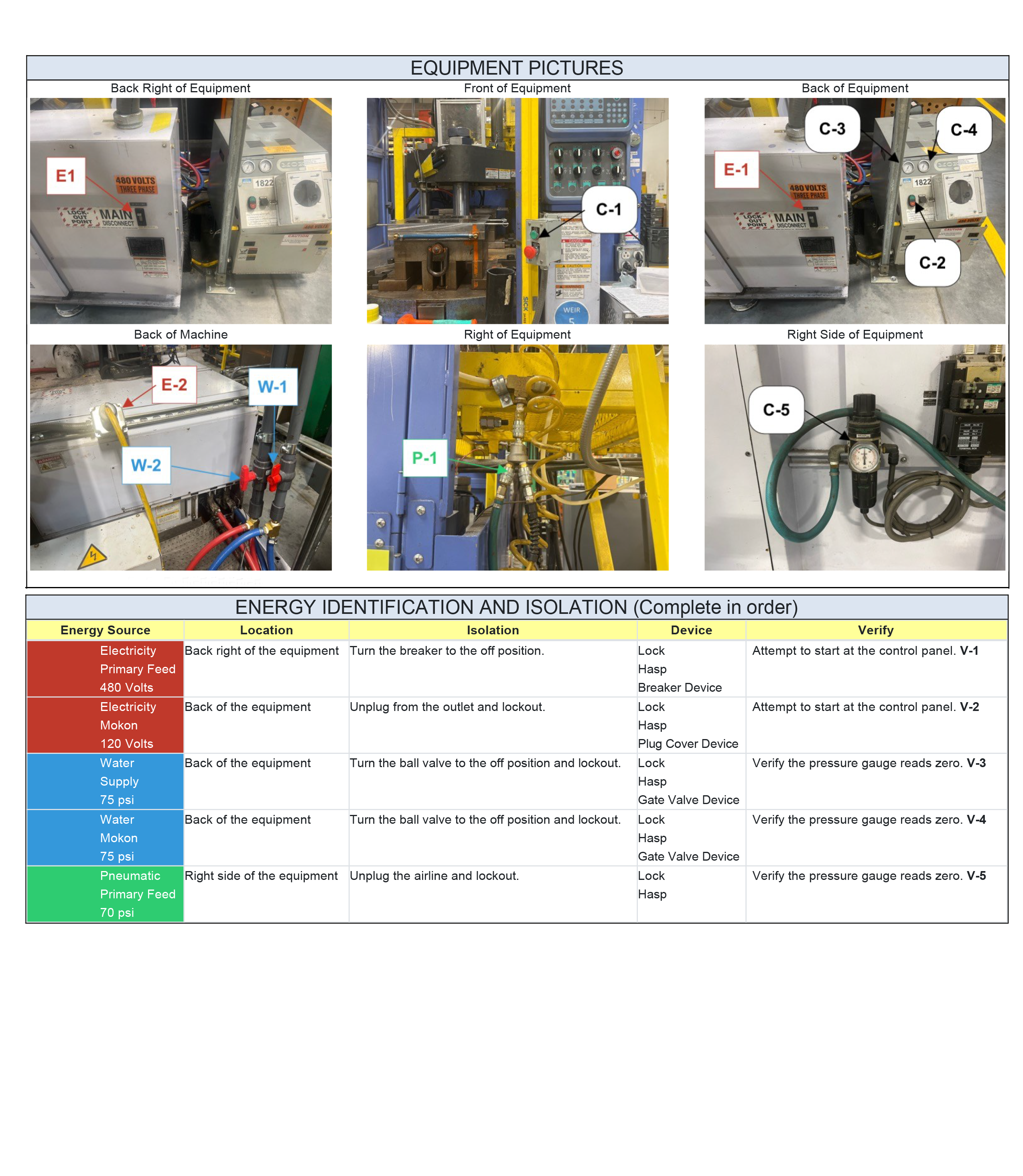
Rather than manually tracking dates in spreadsheets, organizations can maintain procedures in a centralized system and associate each procedure with its equipment, energy sources, isolation points, photographs, inspection history, and employee responsibilities.
A digital LOTO procedure review workflow can also help safety teams:
- Identify procedures approaching their annual inspection date
- Assign inspections to qualified employees
- Document inspection results
- Capture photographs of isolation points
- Identify deficiencies
- Update procedures when equipment changes
- Maintain inspection history
- Record approval of procedure changes
- Generate reports showing completed and outstanding inspections
For organizations operating multiple facilities, centralized software can provide corporate safety teams with visibility into the status of LOTO inspections across different plants.
Don’t Treat the Annual Review as a Paperwork Exercise
The purpose of an annual inspection is not simply to place a check mark beside a procedure.
OSHA explains that periodic inspections are intended to ensure that energy control procedures continue to be implemented correctly, employees understand their responsibilities, and procedural deficiencies are corrected.
A meaningful LOTO procedure review should answer several practical questions:
Does the procedure match the machine as it exists today?
Can employees locate every isolation point?
Are energy sources clearly identified?
Can authorized employees successfully demonstrate the procedure?
Does verification confirm that hazardous energy has actually been controlled?
Have equipment or process changes introduced new hazards?
If the answer to any of these questions is uncertain, corrective action may be necessary.
Building an Effective LOTO Review Program
The simplest approach is to make periodic inspections part of the organization’s normal safety management process rather than treating them as a once-a-year project.
Facilities should establish ownership for procedure inspections, create a recurring schedule, train qualified inspectors, document completed inspections, and establish a process for correcting deficiencies.
The LOTO procedure review process should also connect with management-of-change activities. Whenever engineering, maintenance, or production teams modify equipment, safety personnel should evaluate whether associated lockout/tagout procedures need to be updated.
That connection helps prevent a common problem: modifying equipment today but discovering during next year’s inspection that the LOTO procedure was never updated..
How Smart Safety Pro Can Help with LOTO Procedure Reviews
Smart Safety Pro provides a centralized platform for creating, managing, executing, and inspecting equipment-specific lockout/tagout procedures.
Organizations can maintain digital procedures containing energy sources, isolation points, photographs, shutdown instructions, and return-to-service steps while also managing periodic inspections and approvals.
Instead of relying on spreadsheets and paper documents to determine which procedures are due, safety teams can use a structured system to manage the complete LOTO procedure review lifecycle.
For companies with large numbers of machines, multiple facilities, or frequently changing equipment, digitizing this process can make it easier to keep procedures current and provide documentation showing that required inspections have been completed.
Frequently Asked Questions
This article provides general information about OSHA lockout/tagout requirements and is not legal advice. Employers should evaluate each machine, task, energy source, and workplace condition individually and consult qualified safety or legal professionals when necessary.