

Some repairs require machinery to be temporarily reenergized for testing or positioning. Learn the OSHA-required sequence for removing and reapplying lockout/tagout protection safely.
Maintenance work sometimes reaches a point where a machine must move, cycle, or receive power before the repair can be completed. A technician may need to align a component, test a sensor, check the direction of a motor, reposition a machine part, or confirm that a repair corrected the original problem.
These situations create a difficult transition. The machine has been locked out to protect employees from hazardous energy, but energy must now be temporarily restored.
OSHA permits temporary reenergization when it is necessary to test or position machinery. However, LOTO testing and positioning must follow a defined sequence that removes employees from danger, limits how long the equipment remains energized, and restores full energy-control protection before servicing continues.
Temporary reenergization is not a general exception to lockout/tagout. It applies only for the limited period needed to perform the test or positioning activity.
What Is LOTO Testing and Positioning?
LOTO testing and positioning refers to the temporary removal of lockout or tagout devices and restoration of energy when power or machine movement is necessary to test, adjust, or reposition equipment during servicing.
Examples may include:
- Jogging a motor to verify rotation
- Cycling a machine after replacing a component
- Aligning a gear, shaft, die, or coupling
- Moving a machine component into a serviceable position
- Testing a sensor, limit switch, or interlock
- Checking hydraulic or pneumatic movement
- Confirming that repaired equipment operates correctly
- Positioning a robotic arm for additional maintenance
- Performing a limited functional test after repairs
Under 29 CFR 1910.147(f)(1), lockout or tagout devices may be removed temporarily when machinery must be energized to perform these specific tasks. OSHA requires employers to follow a five-step sequence before, during, and after temporary reenergization.
Temporary Reenergization Must Be Necessary
The first question is whether energization is genuinely required.
LOTO testing and positioning should not be used merely because energizing the equipment is faster, more convenient, or preferred by the maintenance crew. The exception applies when energy is necessary to accomplish the testing or positioning task.
For example, a motor may need power to confirm its direction of rotation. A hydraulic cylinder may need controlled pressure to move a component into alignment. A conveyor may need to move briefly so a technician can evaluate tracking.
By contrast, machinery should remain fully locked out while employees perform tasks that do not require energy, such as:
- Tightening fasteners
- Replacing guards
- Installing components
- Lubricating parts
- Removing tools
- Cleaning equipment
- Completing wiring while circuits are deenergized
- Performing inspections that do not require movement
OSHA has clarified that temporary removal of LOTO devices is permitted only when energization is necessary for the particular testing or positioning task. The equipment must return to a deenergized and locked-out condition before other servicing continues.
The Required Five-Step OSHA Sequence
Every LOTO testing and positioning procedure should include the sequence established in 29 CFR 1910.147(f)(1).
The five required actions are:
Skipping any part of this sequence can expose employees to unexpected movement, electrical energy, pressure, or other hazards.
Testing May Require Multiple Cycles
Complex repairs may require several rounds of testing.
For example, a technician may energize a machine, observe that an adjustment is still required, lock it out again, make the adjustment, and repeat the test.
The required OSHA sequence applies every time locks or tags are removed and energy is restored.
Facilities should not allow the procedure to become less formal with each cycle. Repetition can create complacency, particularly when the first test does not produce unexpected movement.
Every LOTO testing and positioning cycle should include:
- Clearing the machine
- Accounting for employees
- Proper device removal
- Controlled energization
- Complete deenergization
- Reapplication of locks or tags
- Verification before work resumes
The temporary exception does not allow employees to leave equipment energized between repair attempts.
Stored Energy Must Be Reassessed
Temporary movement can create new stored-energy hazards.
A test may:
- Raise an elevated machine component
- Recharge a hydraulic accumulator
- Repressurize a pneumatic line
- Compress a spring
- Heat equipment
- Charge a capacitor
- Move material into a hazardous position
- Create tension in belts, chains, or cables
When the machine is deenergized again, employees must reassess stored energy rather than assuming the original controls remain sufficient.
Blocking, bleeding, restraining, discharging, grounding, or other measures may be required before employees return to the work area.
Effective LOTO testing and positioning procedures should identify how temporary operation can change the equipment’s energy state.
Group Lockout Considerations
Group lockout can make temporary reenergization more complicated because many employees may be protected by a common lockbox or coordinated system.
Before a group test, the primary authorized employee should:
- Identify everyone participating in the lockout
- Explain why energization is required
- Confirm that all employees have stopped work
- Verify that everyone is outside the hazardous area
- Coordinate personal-lock removal
- Inspect the equipment
- Control the test
- Deenergize the system afterward
- Reestablish the group lockout
- Confirm that personal locks have been reapplied
- Verify isolation before work resumes
No employee should return to servicing until the group energy-control system has been fully restored.
The employer should document how LOTO testing and positioning is handled within its group-lockout procedure rather than relying on improvised instructions.
Contractors and Multiple Employers
Contractors are often involved in installations, shutdowns, troubleshooting, and major repairs that require equipment testing.
The host employer and outside employer must exchange information about their respective energy-control procedures. Each employer should understand who controls the temporary reenergization and how all exposed workers will be accounted for.
Before testing begins, the parties should establish:
- Who is the primary authorized employee
- Who controls the equipment
- Who has authority to approve the test
- How contractor personnel are notified
- How personal devices are removed and reapplied
- How employees are cleared from the area
- How test results are communicated
- When contractors may resume work
A contractor should not energize equipment based solely on informal permission from an operator or supervisor.
Common Testing and Positioning Mistakes
Training Employees for Temporary Reenergization
Authorized employees should receive task-specific training on the facility’s LOTO testing and positioning procedure.
Training should address:
- When temporary energization is permitted
- Who may authorize the test
- The required OSHA sequence
- Employee-clearance procedures
- Group-lockout coordination
- Stored-energy reassessment
- Communication methods
- Safe observation positions
- Reapplication of energy controls
- Verification before servicing resumes
Authorized employees must be able to recognize applicable energy sources and understand the methods needed to control them. OSHA also requires employers to certify that required training and retraining have been provided.
Practical exercises can help employees recognize that testing is a controlled exception within the larger energy-control process.
Documenting the Procedure
A machine-specific procedure should explain how testing will be conducted when temporary energization is reasonably foreseeable.
Useful information may include:
- The reason energization may be required
- The components expected to move
- The test controls
- The responsible authorized employee
- The hazardous-area boundaries
- Safe observation locations
- Required guards and barriers
- Communication instructions
- Stored-energy controls
- Emergency shutdown steps
- The sequence for reapplying lockout
- Verification requirements
For complex work, employers may also document each LOTO testing and positioning cycle, including the time, employees involved, reason for testing, results, and confirmation that lockout protection was restored.
Managing Testing Procedures Digitally
Paper LOTO procedures may not clearly describe the transition between deenergized servicing and temporary testing.
A digital energy-control system can help facilities:
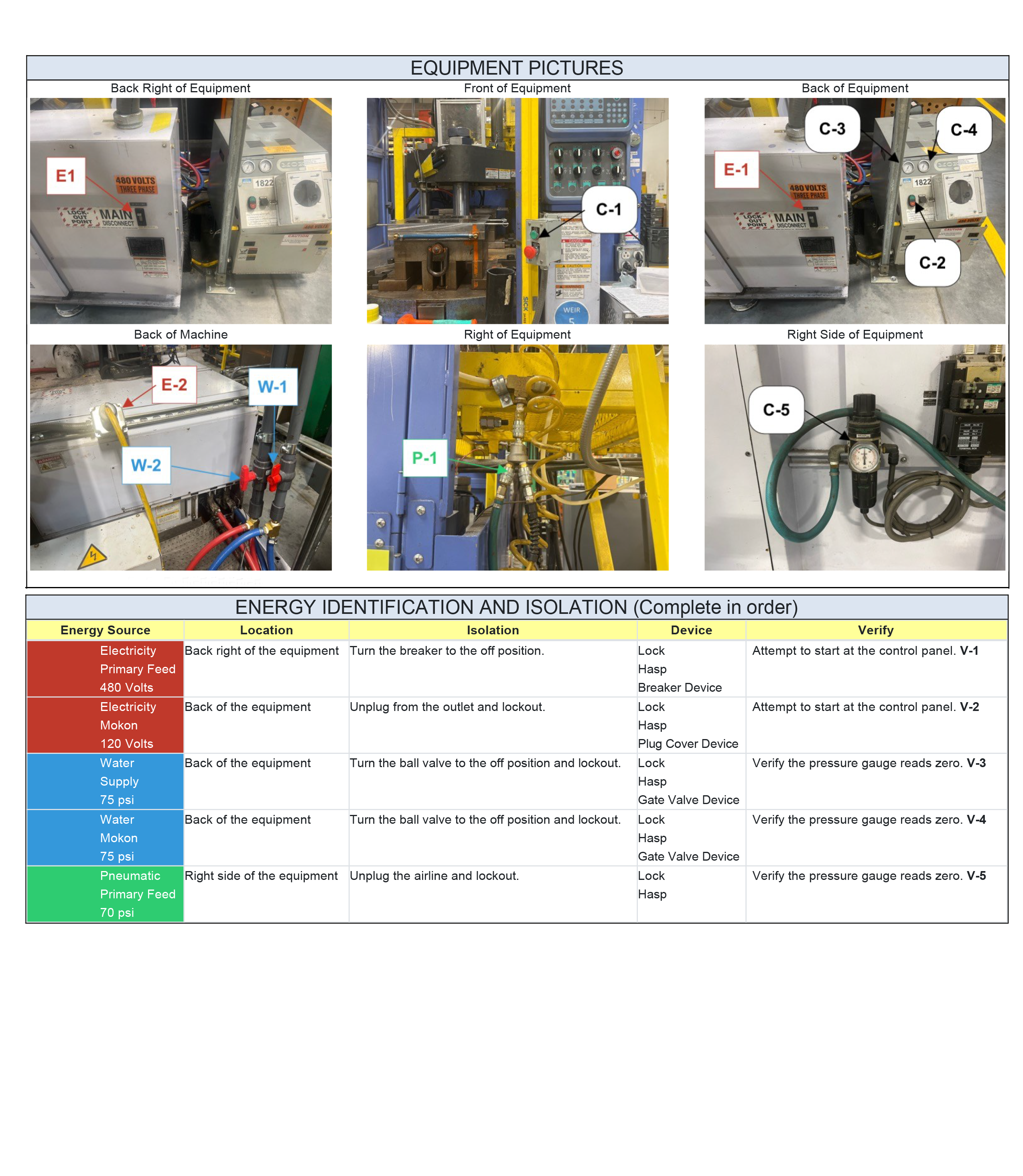
- Create machine-specific instructions
- Identify every energy source
- Show isolation-point photographs
- Define the required test sequence
- Display safe operating positions
- Record authorized employees
- Document temporary lock removal
- Capture testing results
- Record reapplication of energy controls
- Verify return to a zero-energy state
- Maintain procedure revision history
- Complete periodic inspections
Smart Safety Pro helps safety professionals create, access, validate, and inspect machine-specific lockout/tagout procedures.
Mobile access allows authorized employees to review isolation points, photographs, instructions, and verification steps directly at the equipment. Digital records can also help demonstrate that temporary energization was limited to the necessary test and that full hazardous-energy protection was restored afterward.
Final Takeaway
LOTO testing and positioning allows machinery to be temporarily reenergized when power or movement is genuinely necessary to complete a test or reposition a component.
It does not allow employers to suspend lockout/tagout protection for convenience or continue normal servicing while equipment remains energized.
Before energization, the machine must be cleared, employees must be removed or protected, and devices must be properly removed. After the test, all systems must be deenergized, energy controls must be reapplied, stored energy must be addressed, and isolation must be verified before servicing resumes.
A documented and consistently followed procedure helps ensure that the brief transition to energized operation does not become the most dangerous part of the maintenance project.
Smart Safety Pro provides mobile tools for documenting hazardous-energy sources, displaying machine-specific isolation steps, capturing equipment photographs, performing periodic inspections, and maintaining centralized LOTO records.
Frequently Asked Questions
This article provides general information about OSHA lockout/tagout requirements and is not legal advice. Employers should evaluate each machine, task, energy source, and workplace condition individually and consult qualified safety or legal professionals when necessary.